



Picture this: a mid-level manager in Nairobi attends a strategy meeting in the morning, leads a cross-functional team call in the afternoon, and then instead of switching off, logs into a virtual classroom in the evening to debate corporate governance with peers from Germany, Canada, and Vietnam. Same day. Real learning. Zero pause in career drive.
This isn't a rare scenario anymore. It's becoming the standard. And quietly, progressively, it's changing something important about how organizations think, lead, and grow. The rise of the Online MBA in Business Administration isn't just a story about flexible schedules and affordable tuition, it's a story about what happens to a company's culture when its people start learning how to think inversely, lead more confidently, and collaborate across borders without ever leaving their jobs.
The boardroom is being reformed, not by consultants brought in from the outside, but by the people already sitting inside it. According to the Graduate Management Admission Council (GMAC), global enrollment in online MBA programs grew by over 40% between 2019 and 2023, with demand continuing to surge post-pandemic as experts seek flexible pathways to leadership without stepping away from their careers.
Why the Traditional MBA Model Started Showing Its Cracks?
For periods, the MBA was treated like a rite of passage that required sacrifice, two years offline, six-figure tuition, and the unspoken understanding that you'd emerge transformed but financially depleted. For numerous talented professionals, especially those outside North America and Western Europe, that model was simply out of reach. Geography, cost, family responsibilities, and the fear of losing career momentum kept the door closed.
Then online education grew up. Not in a watered-down, corner-cutting way, in a frankly rigorous, globally connected, technologically sophisticated way. The Online MBA in Business Administration evolved from a backup option into a first choice. And the professionals choosing it aren't settling. They're being planned.
The Ripple Effect No One Talks About Enough
Here's what the headlines typically miss. When an employee completes an Online MBA, while staying in their role, they don't just become more qualified, they directly apply what they're learning. That's the compounding advantage that classroom-only programs can't replicate.
A marketing director studying organizational behavior starts running her team meetings differently the very next week. A supply chain manager learning financial modeling brings a sharper lens to budget conversations on Friday after a Wednesday night lecture. The theory doesn't sit in a notebook waiting to be used someday. It gets field-tested in real time, in real organizations, with real stakes.
And that has a quantifiable effect on workplace culture. Teams led by people who are actively learning tend to be more open to change, more data-informed in their decisions, and more willing to question the "way we've always done it." That kind of intellectual energy is contagious, in the best possible way.
One of our learners said – “The most valuable thing about studying online wasn't the credential. It was that I could test every module's ideas directly in my workplace and bring real dilemmas back to class. My team became my living case study."
Diversity of Thought - Built Right Into the Program
One of the most underrated strengths of online MBA associates is who's in the room or rather, who's in the virtual room. Unlike regionally concentrated on-campus programs, online cohorts routinely pull professionals from dozens of countries, industries, and functional backgrounds into the same collaborative space.
When a healthcare administrator from South Korea, a fintech entrepreneur from Brazil, and a logistics manager from the UAE sit in the same breakout group debating market entry strategy, everyone's thinking expands. These aren't hypothetical diversity wins. They're the practical building blocks of global business fluency, something increasingly non-negotiable for leaders operating in today's interconnected economy.
This exposure doesn't stay confined to the classroom either. It flows back into establishments as a broader perspective, sharper cross-cultural communication, and leaders who instinctively think beyond their own market or department.
Corporate Culture Is Changing and HR Knows It
Forward-thinking businesses have noticed. A growing number of organizations, from mid-sized tech firms to global conglomerates, now actively sponsor employees to pursue an Online MBA in Business Administration as part of their talent retention and leadership development strategies. It's not charity. It's a calculated asset.
According to a LinkedIn Workplace Learning Report, companies that invest in employee education see 24% higher profit margins than those that don't. When people feel their employer is invested in their growth, discretionary effort goes up, turnover goes down, and the internal talent pipeline deepens. Everyone wins.
The culture shift is real and measurable: organizations where multiple team members are pursuing or have completed online MBAs tend to report stronger cross-functional collaboration, more structured approaches to problem-solving, and a noticeably higher appetite for strategic risk-taking grounded in evidence rather than instinct.
What It Actually Takes and Why That Matters?
Let's not romanticize it totally. Completing an Online MBA in Business Administration while holding down a full-time job is genuinely demanding. Most programs need 15 to 20 hours of study per week, alongside group projects, case submissions, and live sessions across time zones. It requires a lot of discipline, time management, and self-accountability.
But here's the thing, those very qualities are exactly what make a great leader. The process of completing the degree is, in itself, a leadership development exercise. Graduates don't just arrive with new knowledge. They arrive with demonstrated capacity to manage complexity, deliver under pressure, and commit to long-term goals. Employers don't miss that signal.
The Bigger Picture: Education as a Cultural Catalyst
Zoom out for a moment. Across industries and continents, the organizations that will define the next decade of business aren't necessarily the ones with the biggest budgets. They're the ones building cultures of continuous learning, where curiosity is rewarded, where ideas can come from any level, and where leadership isn't hoarded at the top but developed throughout.
The rise of the Online MBA in Business Administration is both a symptom and a driver of that shift. More accessible education means more diverse leadership. More diverse leadership means richer thinking. Richer thinking means better decisions. Better decisions mean stronger, more resilient organizations. It really does cascade like that. And it starts with one person deciding to learn while they lead.
Whether you're a professional ready to take the leap, a manager looking to sponsor a team member, or an HR leader rethinking your talent strategy, the conversation around online business education is no longer a niche one. It's a mainstream, urgent, and genuinely exciting part of how the corporate world is growing up. The boardroom transformation is already underway. The only question is whether your organization is inside it or watching from the outside.
FAQs
1. Credibility of online vs on-campus MBA
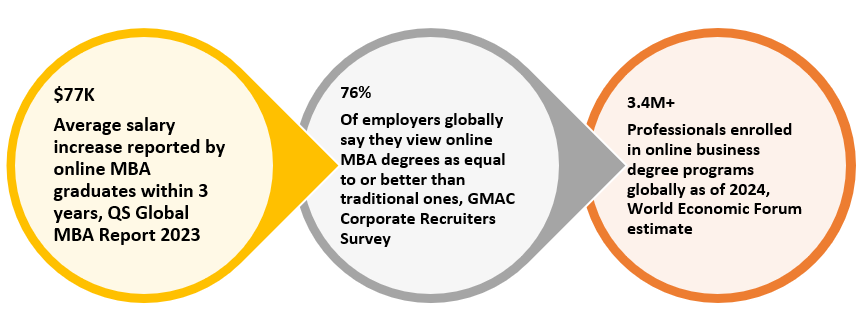
Ans - According to the GMAC Corporate Recruiters Survey, 76% of employers worldwide consider online MBA degrees equal to or better than traditional ones. The key is accreditation. Look for programs accredited by globally recognized bodies like AACSB, AMBA, or EQUIS, these are the gold standards that employers trust. A degree from an accredited institution like EBU carries the same weight on your resume regardless of how it was delivered.
2. Time commitment while working full-time
Ans - Most Online MBA in Business Administration programs require between 15 to 20 hours per week, spread across lectures, readings, group projects, and assignments. That's roughly 2 to 3 hours on weekday evenings and a longer block on weekends. It's demanding, but entirely manageable with consistent scheduling. Program duration typically ranges from 18 months to 3 years, depending on whether you choose an accelerated or part-time pace.
3. Career progression and salary impact
Ans - The QS Global MBA Report found that online MBA graduates report an average salary increase of $77,000 within three years of completing their degree. Beyond the numbers, the strategic thinking, financial literacy, and leadership frameworks you gain make you a stronger candidate for senior roles across virtually every industry.
For career switchers, the MBA is particularly powerful because it signals broad business competence, not just domain-specific expertise. Whether you're moving from engineering to product management or from operations to consulting, the Online MBA in Business Administration gives you the business language and credibility to make that jump convincingly.
4. Networking in an online format
Ans - Better than most people expect and, in some ways, richer than traditional programs. Online MBA cohorts are typically global by design, connecting you with professionals from dozens of countries and industries. Your network isn't limited by geography; it's built across continents. Many programs supplement online learning with residential weekends, international immersion modules, and alumni events that create face-to-face connection.
Additionally, because you remain employed throughout the program, you're simultaneously building your professional network in your current industry while expanding your academic one, a dual advantage on-campus students don't always have.
Written By : Philip Campbell