


When most people hear Master of Arts in Counselling, they immediately picture a traditional therapist working one-on-one with clients. While that's definitely a meaningful and impactful path, it's only a small part of a much superior picture.
In today's fast-evolving, emotionally compound world, counselling skills are in demand across industries, from corporate boardrooms and schools to humanitarian organisations with digital platforms. A Master of Arts in Counselling doesn't just prepare you to listen, it prepares you to lead, guide, and influence human behaviour in various, high-impact environments.
In this blog, let's explore some lesser-known, universally relevant career paths that are opening up for counselling professionals and why this field is becoming one of the most future-proof career choices nowadays.
According to the World Health Organization, depression and anxiety cost the global economy nearly $1 trillion per year in lost productivity. This has pushed companies worldwide to prioritise mental health like never before.
Corporate Wellness & Employee Assistance Expert
Workplaces are no longer just about output, they're about people. With rising awareness around burnout, stress, and mental health, organisations are investing heavily in employee well-being. That's where counselling professionals step in. As a corporate wellness specialist, you may:
- Design mental health programs
- Offer confidential counselling support
- Conduct stress management workshops
- Build psychologically safe workplaces
School & Educational Counsellor (Beyond the Fundamentals)
Yes, school counselling is a recognized path but today's role is far more dynamic than before. Current educational counsellors are not just handling student issues; they are shaping learning ecosystems. With a Master of Arts in Counselling, you can:
- Support students with academic, emotional, and behavioural challenges
- Work on inclusive education and SEN (Special Educational Needs)
- Guide career decisions and life skills development
- Collaborate with teachers and parents for holistic development
This role is particularly growing across regions like the UAE, Southeast Asia, and Europe, where schools are gradually integrating mental health into their frameworks.
Career & Life Coach
Not everyone needs therapy but almost everyone needs direction. That's why career and life coaching is flourishing globally. With counselling training, you bring deeper psychological insight into coaching, helping individuals:
- Navigate career transitions
- Overcome self-doubt and limiting beliefs
- Set realistic goals
- Build confidence and precision
Unlike generic coaching, counselling-based coaching is more organized, ethical, and impactful, making you stand out in a packed market.
Rehabilitation & Crisis Counsellor
If you're ambitious by purpose and impact, this path can be incredibly fulfilling. Rehabilitation and crisis counsellors work with individuals facing:
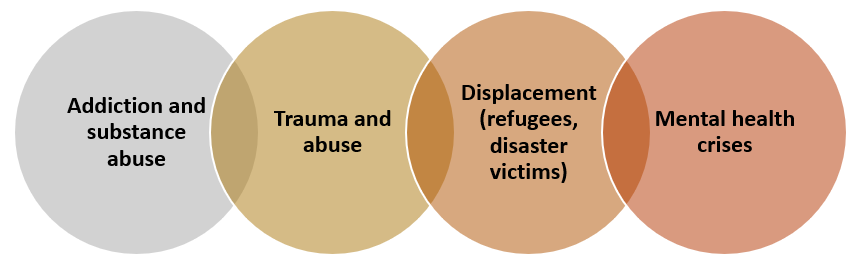
You could work with NGOs, hospitals, or international organisations, contributing to real change on the ground. The International Labour Organization highlights a rising need for psychosocial support professionals in humanitarian and conflict-affected areas, making this a critical worldwide career pathway.
Digital Mental Health Consultant
Welcome to one of the fastest-growing spaces, mental health meets technology. From mental health apps to online therapy stages, there's a rising demand for professionals who understand both psychology and digital behaviour. As a digital mental health consultant, you might:
- Design user-friendly mental wellness programs
- Create content for mental health platforms
- Work with ed-tech or health-tech companies
- Analyse user behaviour to improve engagement
This role is particularly relevant in a post-pandemic world where virtual support systems are becoming the norm.
Organisational Behaviour & HR Specialist
Human Resources is no longer just administrative, it's intensely psychological. Companies now seek professionals who understand people, motivation, and workplace dynamics. With a counselling background, you can work in HR roles focusing on:
- Conflict resolution
- Employee engagement
- Leadership development
- Workplace culture transformation
Your aptitude to understand emotions and behaviour gives you a strong edge over traditional HR profiles.
Family & Relationship Consultant
Contemporary relationships are evolving and so are their challenges. From cross-cultural marriages to digital-age communication gaps, people are increasingly seeking guidance. A career in relationship counselling allows you to:
- Work with couples and families
- Address communication issues
- Support parenting strategies
- Guide conflict resolution
This can be pursued independently (private practice) or through clinics and counselling centres.
How Educational Psychology Shapes the Way We Learn?
Policy & Advocacy Specialist in Mental Health
If you want to influence change at a larger scale, this path is for you. Governments and global organisations are progressively recognising mental health as a policy priority. With your counselling background, you can contribute to:
- Mental health awareness campaigns
- Policy development
- Research and advocacy initiatives
- Community-based intervention programs
This role balances psychology with social impact, ideal for those who want to create systemic change.
Why This Field Is Budding Faster Than Ever?
The demand for counselling professionals is not just rising, it's accelerating globally. According to the U.S. Bureau of Labor Statistics, employment of substance abuse, behavioural disorder, and mental health counsellors is expected to grow 18% from 2022 to 2032, which is much faster than the average for all occupations.
This growth is being driven by:
- Increasing mental health awareness
- Workplace stress and burnout
- Digital lifestyle challenges
- Greater focus on emotional well-being in education
In short, the world needs more professionals who understand people and that's exactly what counselling prepares you for.
Ending Thoughts
A Master of Arts in Counselling is no longer incomplete to traditional therapy roles, it's a gateway to diverse, impactful, and internationally relevant careers. Whether you see yourself working in a corporate office, a school, a humanitarian organisation, or even a digital platform, the opportunities are expanding faster than ever.
What makes this field truly powerful is its versatility? You're not just choosing a job, you’re choosing a skill set that adapts across industries, cultures, and future trends. So, if you’ve been thinking that counselling is "too narrow" as a career choice, it might be time to reconsideration. Because in a world that's continually evolving, the ability to understand and support human behaviour isn't just valuable, it's important.
FAQs
Is counselling a good career choice worldwide?
Yes, counselling is a fast-growing global career. With growing awareness of mental health, there is strong demand across countries in sectors like education, corporate wellness, healthcare, and humanitarian work. Job growth in counselling-related fields is projected to grow significantly over the next decade.
Can I work globally with a counselling degree?
Yes, but requirements vary by country. While numerous roles like coaching, corporate wellness, and educational counselling are globally accessible, clinical or licensed therapist roles may require additional certifications or local licensing depending on the country.
What skills do you gain from a Master of Arts in Counselling?
You develop key skills such as active listening, emotional intelligence, communication, problem-solving, conflict resolution, and behavioural analysis. These skills are transferable across multiple industries, making you highly adaptable in the global job market.
Can I work in the corporate sector after studying counselling?
Yes, numerous companies hire counselling professionals for roles in employee well-being, HR, leadership development, and organisational behaviour. Your understanding of human psychology gives you a strong advantage in managing workplace dynamics.
Is there demand for digital or online counselling careers?
Absolutely. With the rise of teletherapy, mental health apps, and online coaching platforms, digital counselling roles are expanding quickly. Professionals can work remotely while supporting clients globally.
Do I need a license to work as a counsellor?
It depends on your role and location. Clinical counselling or therapy typically requires licensing, while roles in coaching, corporate wellness, or education may not always require formal licensure but benefit from certifications.
Written By : Tammy C. Bow