


We are presently living through a reflective cultural shift. Over the last few years, the global conversation around mental health, workplace culture, and human behavior has blown wide open. It’s no longer an intangible topic discussed behind closed doors; it’s on our social feeds, in our corporate boardrooms, and at our dinner tables. People everywhere are recognizing that emotional and psychological well-being are foundational to a functional society.
Because of this, understanding why people do what they do has become one of the most appreciated skill sets in the modern economy.
Major Career Sectors to Explore
If you have ever found yourself captivated by human interaction, conflict resolution, or consumer habits, you have likely thought about looking into foundational Psychology Courses. However, if you are presently managing a full-time job, caring for a family, or living far from a major university campus, sitting in a traditional lecture hall might feel entirely out of reach.
That is where pursuing an Online Psychology Degree enters the picture. It bridges the gap between personal ambition and everyday reality, allowing you to study global human dynamics from your own living room without putting your life on hold.
But what happens after you click "submit" on your final assignment?
Let’s dispel the biggest myth in education: a psychology degree does not lock you into a single path of becoming a clinical therapist. The career options are far wider, more diverse, and faster-growing than most people realize.
The Exploding Demand for Behavioral Expertise
To understand where a psychology degree can take you, it helps to look at the international numbers. The demand for professionals who understand human dynamics is skyrocketing worldwide, driven by a collective reduction in mental health stigma and a massive post-pandemic focus on wellness.
According to data from the U.S. Bureau of Labor Statistics, the employment of substance abuse, behavioral disorder, and mental health counselors is projected to grow by an impressive 17% over the next decade, a rate that is vastly faster than the average for all occupations combined. Furthermore, the broader sector of outpatient mental health practitioner offices is anticipated to expand by 26.4% in the same timeframe.
This isn't just a North American phenomenon. Across the globe, countries are realizing they face a critical shortage of behavioral health specialists. For instance, workforce data from Australia shows an expected five-year growth of over 14% for dedicated counselors, alongside a 23.2% surge in demand for community and youth workers.
When you study psychology, you aren't just learning abstract theories about the brain. You are gaining a multipurpose toolkit in critical thinking, data analysis, empathetic communication, and cultural awareness, skills that are universally needed across dozens of industries.
Major Career Sectors to Explore
Let’s look at the real career tracks that open up when you hold a degree in psychology. Depending on your personal goals, you can take this education into the clinical space, the corporate world, or cutting-edge tech environments.
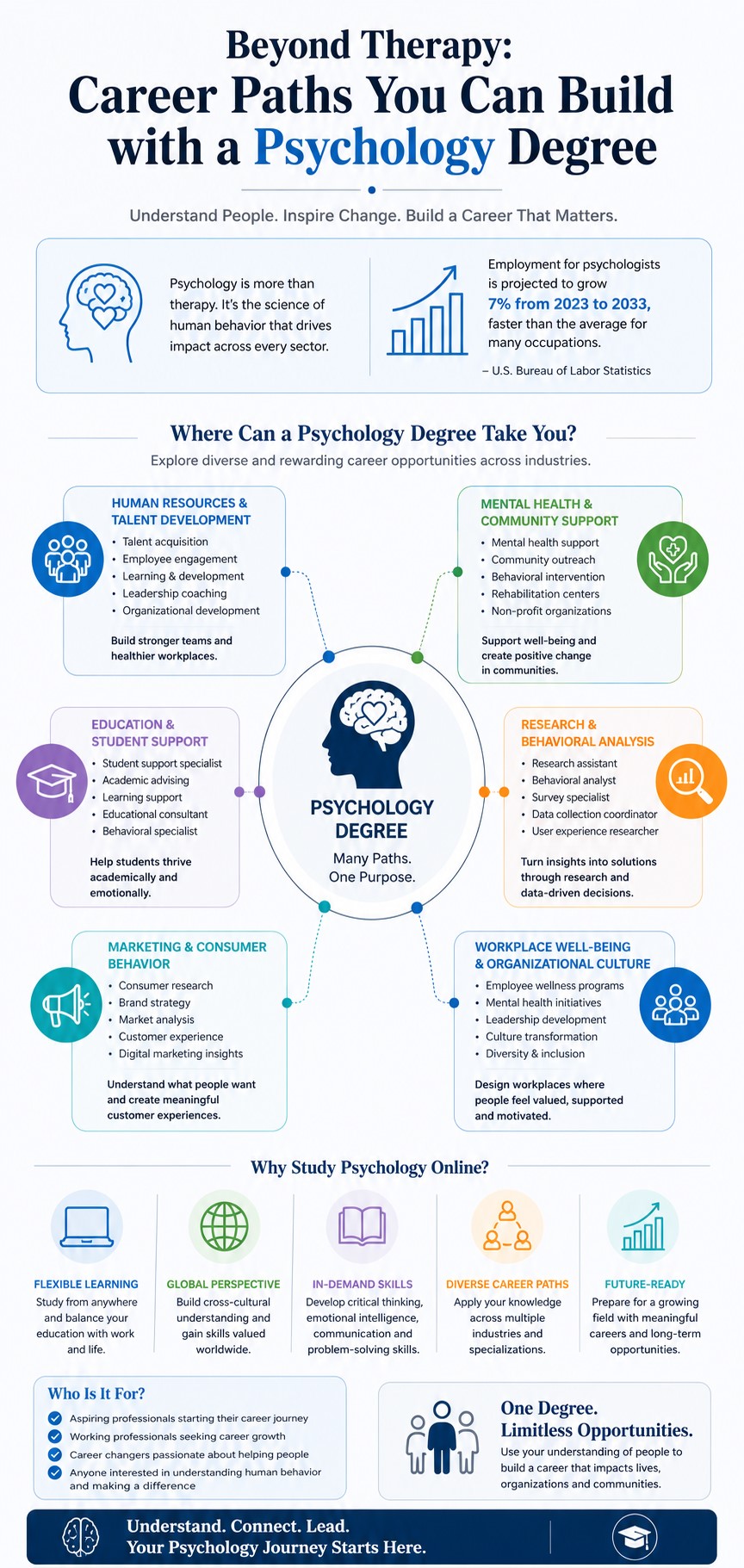
Mental Health, Counseling, Community and Social Services
This is the classic path, but it has experienced a modern, digital evolution. The rise of telehealth has totally decentralized mental health support, making it accessible to remote and underserved communities globally.
- Mental Health Counselor: Working in clinics, schools, or private practices to help individuals manage stress, anxiety, or life transitions.
- Case Manager or Social Services Advocate: Coordinating care and resources for vulnerable populations, including families in crisis, veterans, or the elderly.
- Crisis Intervention Specialist: Providing immediate, vital support in community outreach centers or digital support hotlines.
You can also explore Community outreach programs, Rehabilitation centers, NGOs, Behavioral intervention programs. These roles focus on supporting individuals and communities through evidence-based approaches to well-being. While entry-level counseling, intake, and support roles are extensively accessible with a bachelor’s degree, moving into specialized clinical practice or becoming a fully licensed psychologist typically requires advanced graduate studies.
Corporate Culture, HR, and Talent Development
Have you ever wondered why you click on certain apps, buy specific products, or trust certain brands over others? That is applied psychology in action.
- User Experience (UX) Researcher: Working with tech developers to study how users interact with software, ensuring apps and websites are intuitive and user-friendly.
- Market Research Analyst: Analyzing consumer trends and behavioral data to help companies understand what products people want and how to communicate effectively with them.
- Brand Strategist: Crafting marketing campaigns that resonate deeply with human emotions and values.
Criminal Justice and Rehabilitation
Understanding the psychological factors behind criminal behavior is vital for creating effective rehabilitation systems, reducing recidivism, and designing fair community safety programs.
- Correctional Counselor: Working within the justice system to help individuals rehabilitate and successfully reintegrate into society.
- Victim Advocate: Supporting survivors of crime through the complex legal and emotional recovery processes.
- Probation or Parole Officer: Guiding individuals as they navigate the terms of their release and work toward positive behavioral changes.
Education and Student Support
Educational institutions increasingly prioritize emotional well-being alongside academic achievement. Psychology graduates may contribute as:
- Student support specialists
- Academic advisors
- Learning support coordinators
- Educational consultants
- Behavioral specialists
Their expertise helps create healthier and more effective learning environments.
Marketing and Consumer Behavior
Marketing today is deeply influenced by psychology. Understanding why people make purchasing decisions helps organizations design better campaigns and customer experiences.
Psychology graduates often contribute to:
- Consumer research
- Brand strategy
- Market analysis
- Customer experience design
- Digital marketing insights
Their aptitude to understand human motivation gives businesses a competitive advantage.
The Growing Demand for Workplace Well-Being Experts
One of the most significant global trends is the growing emphasis on employee wellness. Burnout, stress management, and mental health support have become major priorities for employers worldwide.
Organizations are investing in professionals who understand human behavior and workplace psychology. This has created opportunities in:
- Employee wellness programs
- Workplace mental health initiatives
- Leadership development
- Organizational culture transformation
- Diversity and inclusion programs
Psychology professionals are increasingly helping organizations create healthier, more productive work environments.
Why the Online Path Fits the Modern Professional?
Choosing to pursue your education online isn't just about convenience, it actually mirrors the way the modern digital economy works. When you enroll in an Online Psychology Degree, you develop unique professional advantages that traditional classrooms can't always replicate.
- You’ll study alongside peers from completely different cultures and backgrounds, giving you instant insights into how different societies view mental health and human behavior.
- Managing digital platforms, online research databases, and virtual collaborative tools builds the exact technical communication skills required for today’s remote and hybrid workforces.
- Successfully balancing independent study with your personal and professional life demonstrates a level of time management and grit that employers highly value.
The foundational curriculum you encounter in these programs covers everything from developmental psychology and social behavior to statistical research methods. A robust selection of Psychology Courses ensures that your degree carries the exact same academic weight and professional respect as an on-campus equivalent, while giving you the freedom to learn at a pace that respects your existing lifestyle.
Final Thoughts
Psychology is no longer confined to clinics and counseling centers. Its principles influence business, education, healthcare, technology, public policy, and countless other sectors. As organizations place greater emphasis on understanding people, psychology professionals are finding opportunities in fields that did not traditionally recruit psychology graduates. Whether supporting workplace well-being, conducting behavioral research, improving customer experiences, or leading teams, psychology skills have become increasingly relevant in a rapidly changing world.
An Online Psychology Degree offers a flexible and accessible route into this evolving landscape, while targeted Psychology Courses can help professionals enhance specific competencies. For individuals seeking meaningful careers built around understanding and supporting people, psychology continues to offer some of the most versatile and impactful opportunities available today.
Written By : Philip Campbell