


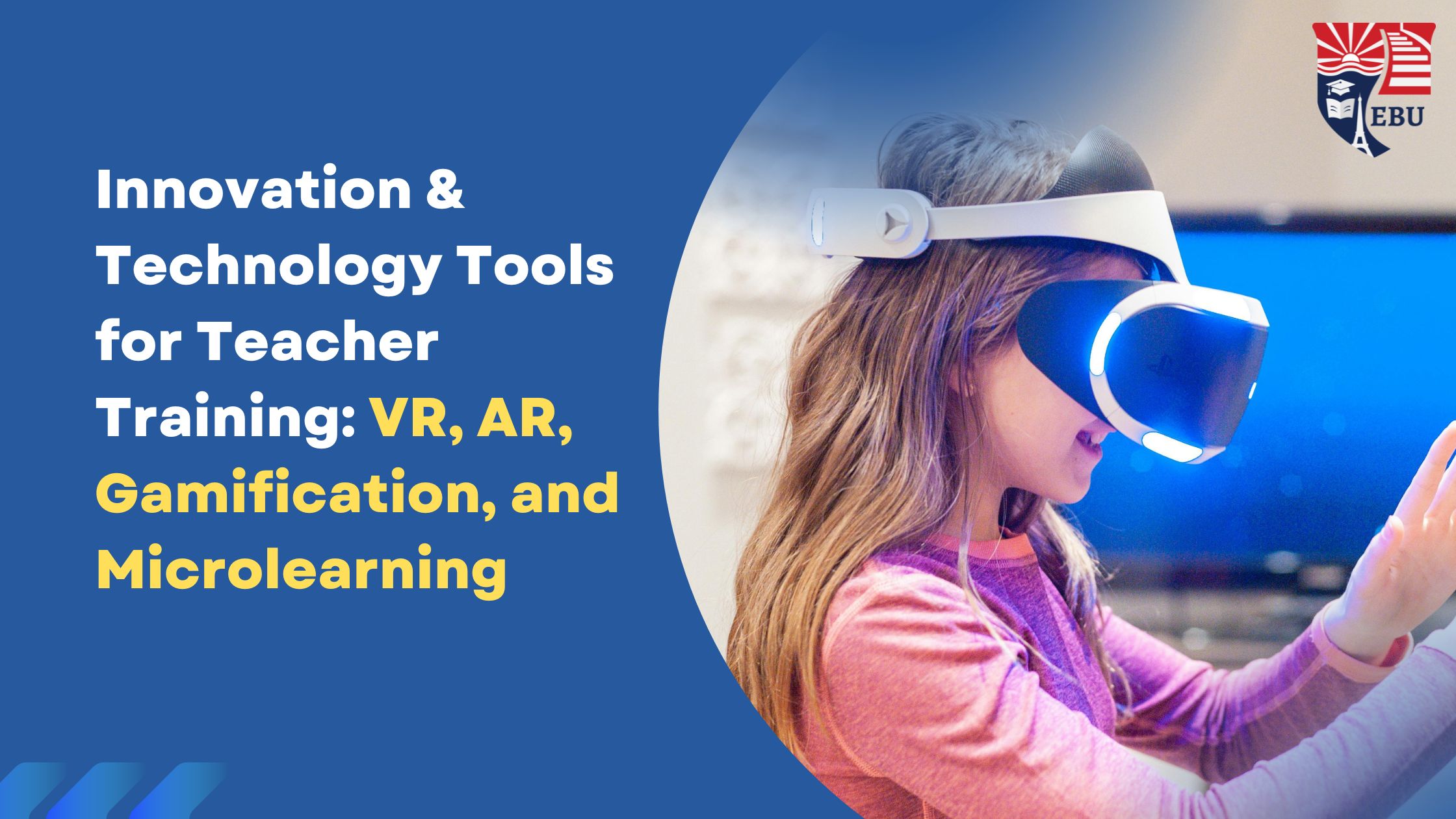
In the fast-evolving field of education, teacher training is undergoing a reflective transformation. The traditional chalk-and-talk approach is being replaced by immersive, interactive, and personalized learning experiences.
Students who are pursuing a Bachelor of Education or an Online B.Ed. Degree today are not only learning pedagogy and theory but also engaging with cutting-edge technologies that prepare them for 21st-century classrooms. Among the most promising innovations are Virtual Reality (VR), Augmented Reality (AR), gamification, and microlearning - tools that are redefining how future educators learn to teach.
Let’s discusses the advantages and limitations of each technology, showcases global examples, and emphasizes the importance of blending innovation with pedagogy to create adaptable, tech-savvy educators ready for contemporary classrooms.
1. Virtual Reality (VR): Experiencing the Classroom Before Teaching It
Virtual Reality allows teacher trainees to step into simulated classrooms where they can practice teaching without the pressure of real-world consequences. Instead of observing live classes passively, B.Ed. students can engage in realistic classroom scenarios that test their instructional skills, classroom management, and empathy.
For example, the University of Glasgow’s teacher training program uses VR simulations to immerse students in diverse classroom settings. Trainees interact with AI-driven student avatars that mimic real-life behaviors - disruptive learners, shy students, or those needing special attention. This kind of experiential learning helps future teachers build confidence and adaptability.
Pros:
- Offers a safe, controlled space for practice
- Enhances empathy and understanding of student diversity
- Provides instant feedback through analytics
Cons:
- High cost of VR hardware and software
- Limited access for online learners with low bandwidth
2. Augmented Reality (AR): Blending Real and Digital Classrooms
While VR immerses learners in a virtual world, Augmented Reality overlays digital elements onto the real environment. AR tools such as Google Expeditions and Merge Cube allow teacher trainees to bring abstract concepts to life, for instance, showing 3D models of the solar system or historical artifacts directly in the classroom.
In the context of a Bachelor of Education curriculum, AR helps future educators visualize how technology can make complex subjects more engaging for their own students. It also teaches them to design AR-integrated lesson plans that encourage interactive learning.
Pros:
- Enhances visualization and concept clarity
- Encourages creativity in lesson design
- Requires only a smartphone or tablet
Cons:
- May distract learners if not used purposefully
- Requires digital literacy and training support
3. Gamification: Turning Learning into Play
Gamification integrates game mechanics - points, badges, leaderboards, and challenges - into the learning process. For teacher training, this approach promotes motivation, collaboration, and reflective learning. Many Online B.Ed. Degree programs now use gamified platforms to teach classroom management strategies or to simulate lesson delivery challenges.
For instance, platforms like Classcraft and Kahoot are more and more used in teacher education. They allow B.Ed. students to experience the same engagement tools they might later use in their classrooms. Gamification fosters competition, rewards effort, and builds a sense of community among online learners who might otherwise feel disconnected.
Pros:
- Boosts engagement and intrinsic motivation
- Reinforces learning through challenges and rewards
- Promotes social learning and peer interaction
Cons:
- Risk of focusing more on points than pedagogy
- Requires thoughtful alignment with learning objectives
4. Microlearning: Small Lessons, Big Impact
In an age of information overload, microlearning - delivering content in short, focused bursts - has become essential for modern education. For Online B.Ed. Degree students, microlearning modules offer flexibility and accessibility, allowing them to study while balancing work or family responsibilities.
Microlearning might include five-minute video lessons on classroom behavior strategies, interactive quizzes on educational psychology, or quick reflection prompts after a teaching simulation. Universities like the University of Phoenix and Walden University integrate microlearning into their online B.Ed. programs, enabling students to master specific teaching skills efficiently.
Pros:
- Fits busy student schedules
- Enhances retention through focused content
- Ideal for mobile and asynchronous learning
Cons:
- May oversimplify complex concepts
- Lacks depth if not combined with larger coursework
5. The Road Ahead: Integrating Innovation with Pedagogy
While these technologies - VR, AR, gamification, and microlearning - offer remarkable benefits, their success in teacher education depends on thoughtful integration into the Bachelor of Education curriculum. The goal is not to replace traditional teaching but to enhance it with meaningful digital experiences.
Teacher educators must ensure that trainees not only use these tools but understand their pedagogical value—how technology can foster inclusion, creativity, and critical thinking. As the global education landscape becomes more digital, the ability to teach with technology will be as vital as the ability to teach about it.
To End With
Innovation in teacher training is not a far-away dream - it’s already happening. As B.Ed. programs worldwide adopt immersive and interactive technologies, they are preparing educators who can thrive in hybrid, global, and tech-enabled classrooms. The next generation of teachers won’t just use technology; they’ll lead with it - transforming classrooms into spaces of curiosity, collaboration, and continuous learning.
Written By : Philip Campbell