

Beyond the Blackboard: The 4 Invisible Leadership Skills Reshaping Modern Education
The international education market is intensifying fast, projected to swell from $7 trillion in 2025 to a staggering $10 trillion by 2030. This progress isn't just about larger student headcounts; it represents a fundamental overhaul of how the world learns. Driven by fast advancements in generative AI, evolving student demographics, and corporate demands for flexible, modular upskilling, education is transitioning into a structural pillar of the digital-first global economy.
A few years ago, being a good educator mostly meant knowing your subject well, managing a classroom self-assuredly, and helping students perform better in exams. Those skills still matter. Nevertheless, today, educators are expected to do much more. They need to understand technology, student well-being, inclusion, data, cultural diversity, policy changes, and the changing expectations of parents, institutions, and employers.
For mid-career educators, academic coordinators, and institutional managers, this shift brings a pressing question: Are you managing an outdated system, or are you equipped to lead its future?
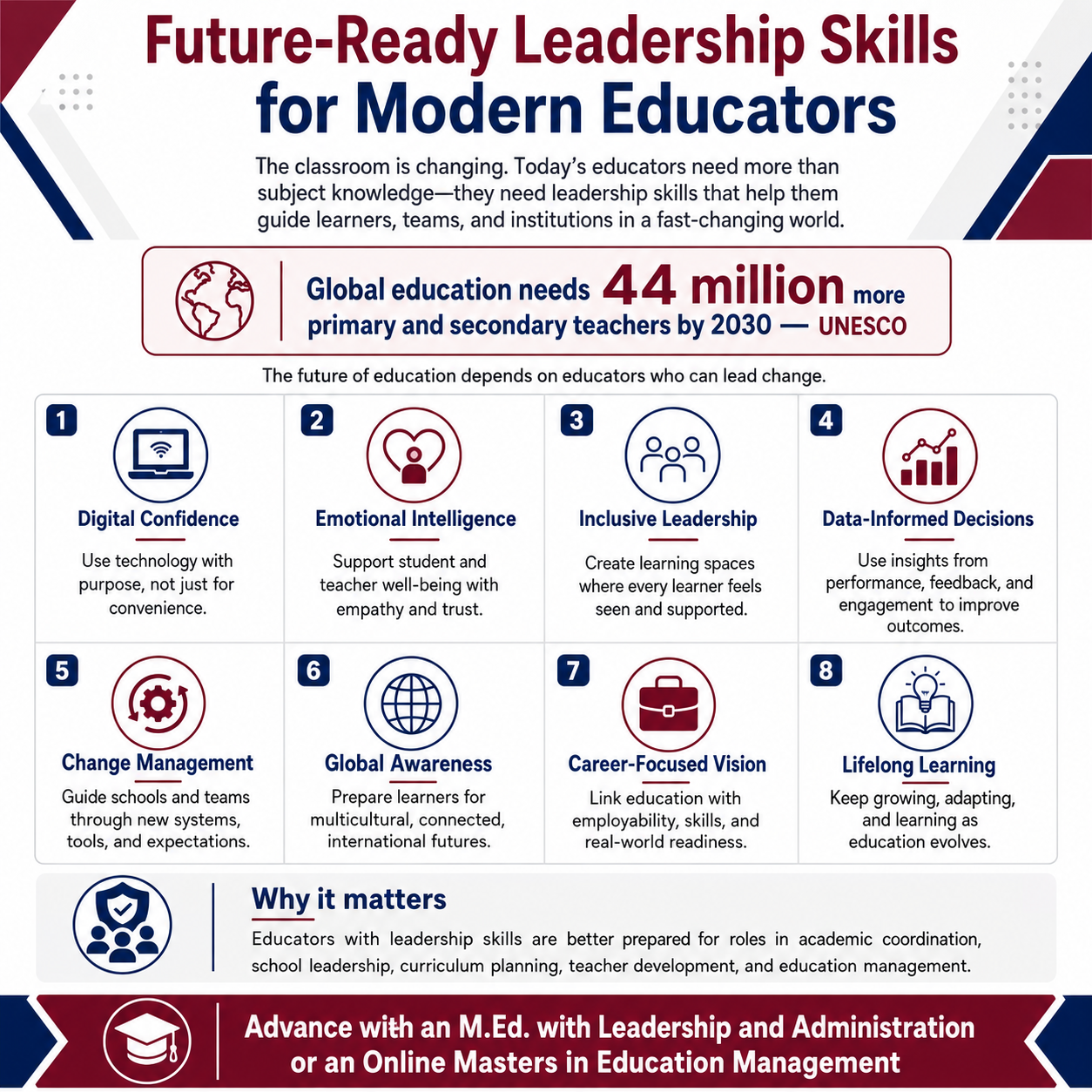
Across the world, education systems are also facing pressure. UNESCO has reported an urgent need for 44 million primary and secondary teachers globally by 2030, highlighting not only a staffing challenge but also a leadership challenge for schools and institutions. That is why numerous professionals are now looking beyond traditional teaching qualifications and exploring programmes such as an M.Ed. with Leadership and Administration to build the skills needed for modern education leadership.
4 Critical, "Invisible" Leadership Skills Are Non-Negotiable
To flourish in this new ecosystem, modern educators must cultivate a sophisticated blend of tech fluency and deep human emotional intelligence. The following four critical, "invisible" leadership skills are non-negotiable for the contemporary educational architect.
1. Digital Confidence, Not Just Digital Awareness
Artificial intelligence, learning management systems, virtual classrooms, digital assessments, and student analytics are now part of everyday education. The real skill is not just using technology. It is knowing when technology progresses learning and when it becomes a distraction. A future-ready educator should be able to ask:
Is this tool helping students think better?
Is it making learning more inclusive?
Is it saving teachers time? Is it protecting student data?
The World Economic Forum’s Future of Jobs 2025 skills outlook highlights AI and big data, analytical thinking, technological literacy, resilience, systems thinking, leadership, and lifelong learning as important skills for the future workplace. These are no longer just corporate skills. They are education leadership skills too.
2. Architectural Agility (Designing for a Borderless Campus)
Education is no longer confined by brick-and-mortar boundaries. A student in Mumbai can flawlessly critique a thesis alongside a classmate in Berlin, guided by an instructor in New York. Futuristic leadership means moving past the transactional mindset of "putting a class on Zoom." Leaders must design intentional, frictionless hybrid ecosystems that accommodate asynchronous lifestyles without losing community consistency. This needs a deep understanding of learning analytics to predict student attrition before it happens, alongside the agility to rearrange curricula dynamically based on real-time workforce trends.
3. Emotional Intelligence for Human-Centred Learning
The future may be digital, but education will always remain deeply human. Students today are dealing with academic pressure, social judgement, uncertainty, mental health challenges, and rapid changes in how they learn and communicate. Educators need emotional intelligence to understand what is happening beyond grades and attendance. For school leaders and academic coordinators, emotional intelligence is even more significant. Teachers also need support, recognition, mentoring, and space to grow. A strong leader does not simply manage performance. They understand people.
4. Intrapreneurial Resource Management
Public and private education sectors alike face a tenacious challenge: doing more with less, even as the international market value climbs. Tomorrow’s leader is fundamentally an internal entrepreneur. You need to identify new institutional revenue streams, forge strategic public-private partnerships, and advocate for sustainable tech infrastructures that lower overhead costs while expanding educational access.
Bridging the Implementation Gap
Recognising these skills is simple; mastering them under the pressure of day-to-day administrative tasks is where most professionals stall. This realism explains why ambitious educators are returning to graduate programs designed specifically for the digital frontier.
Traditional pedagogy degrees focus profoundly on classroom dynamics. However, driving systemic institutional change requires specialized training. Programme tracks like an M.Ed. with Leadership and Administration provide the macro-level strategic foundation needed to manage institutional crises, design equitable fiscal policies, and inspire diverse organizational teams.
For professionals currently balancing full-time roles, accessibility is a critical factor. Choosing a high-caliber Online Masters in Education Management allows leaders to apply advanced organizational psychology and data-driven decision-making frameworks to their current workplaces in real time. It changes the pursuit of a degree from a passive academic exercise into a live laboratory for leadership.
The Mandate for Modern Educators
The future of education needs more than skilled teachers. It needs educators who can think strategically, lead with empathy, use technology responsibly, support diverse learners, and guide institutions through change. Futuristic leadership is not about sounding contemporary. It is about being prepared for real challenges that are already here.
For working teachers, academic professionals, and education managers, developing these skills can open doors to more meaningful roles and stronger career growth. Whether through experience, professional development, an Online Masters in Education Management, or a specialised education leadership pathway, the goal remains the same: to become the kind of educator the future needs.
FAQs
1. What are futuristic leadership skills for educators?
Futuristic leadership skills for educators include digital confidence, emotional intelligence, inclusive thinking, data-informed decision-making, adaptability, global awareness, and the ability to lead change in modern learning environments.
2. Why do modern educators need leadership skills?
Modern educators need leadership skills because teaching today goes beyond classroom instruction. They are expected to support diverse learners, use technology wisely, manage change, improve learning outcomes, and contribute to institutional growth.
3. How can an M.Ed. with Leadership and Administration help educators?
An M.Ed. with Leadership and Administration can help educators build skills in academic leadership, school management, curriculum planning, teacher development, decision-making, and education policy. It is useful for teachers who want to move into leadership or administrative roles.
4. Is an Online Masters in Education Management suitable for working teachers?
Yes, an Online Masters in Education Management is suitable for working teachers because it offers flexibility while helping them develop advanced skills in education leadership, planning, administration, and institutional improvement.
5. What career roles can educators explore after gaining leadership skills?
Educators with strong leadership skills can explore roles such as academic coordinator, school leader, education manager, curriculum specialist, teacher trainer, department head, education consultant, and learning and development professional.

Comments & Replies
Read what others are saying and share your thoughts below.
Leave a Reply