

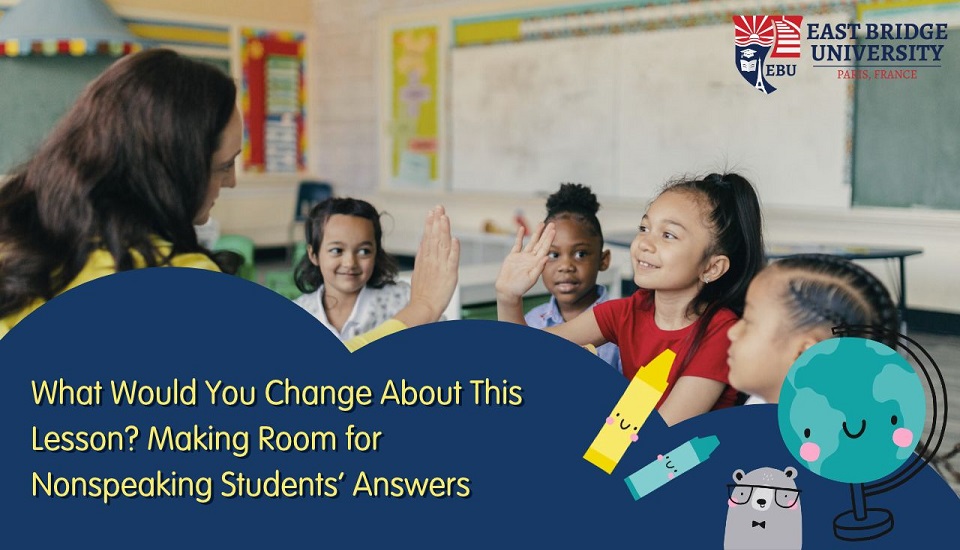
What Would You Change About This Lesson? Making Room for Nonspeaking Student's Answers
A student may not speak, but that does not mean they have nothing to say about a lesson. They may show interest through eye contact, a change in posture, a smile, a gesture, or a pause before choosing an answer. They may communicate discomfort by turning away, becoming still, or disengaging from an activity.
The challenge for researchers and educators is not to “read minds.” Instead, they must create respectful, accessible ways for students to express what helps them learn and interpret those expressions carefully.
For professionals pursuing an applied doctorate in special education or SEN, this question is essential. Research should not merely study students with complex communication needs; it should create opportunities for them to be heard as experts in their own learning.
Why Does Student Voice Matter?
Every learner has preferences. Some enjoy practical activities; others prefer visual explanations, predictable routines, quiet spaces, music, movement, or time to process information. These preferences matter in every classroom, but they become especially important when a student communicates in ways beyond spoken words.
Too often, adults assume they know what works. A teacher may decide that a student enjoys a sensory activity because the student appears calm. A researcher may interpret a smile as enjoyment, even though it could reflect many different feelings. Without careful methods, adult assumptions can replace the student’s perspective.
Globally, this is not a small issue. The World Health Organization estimates that 1.3 billion people, about 16% of the world’s population, experience significant disability. UNICEF estimates that nearly 240 million children worldwide have some form of disability. These learners are part of classrooms, communities, and future workforces everywhere.
Their voices deserve to shape educational research, not simply be described through the observations of others.
Start With Access, Not Assumptions
Accessible interviews begin long before the first question is asked. A researcher must ask: How can this student participate in a way that is meaningful, comfortable, and authentic?
That may involve:
- Using pictures, symbols, objects, photographs, or video clips.
- Offering choices through eye-pointing, gestures, switches, touchscreens, or augmentative and alternative communication (AAC).
- Allowing a trusted communication partner to support the process without speaking for the student.
- Conducting the conversation in a familiar, quiet, and sensory-friendly environment.
- Breaking questions into short, concrete parts.
- Repeating or rephrasing questions in different formats.
- Giving the student control over pacing, breaks, and the option to stop.
- Accessibility is not about lowering expectations. It is about removing barriers so that expectations can be meaningful.
UNICEF notes that assistive technology can support communication, mobility, self-care, development, wellbeing, and access to essential services for children with disabilities. In a research setting, that principle applies equally: the right communication tools can turn a one-sided interview into a genuine exchange.
Give Time for a Response
In many interviews, silence is treated as a problem. Researchers may rush to fill it, repeat the question, or move on before a student has had time to respond.
But silence can be communication. A student using AAC may need time to locate words, navigate a device, or physically select a response. Another student may need time to process language, decide how they feel, or prepare a gesture. A third may respond through facial expression or body movement, which requires observation over time rather than an instant answer.
A thoughtful researcher builds waiting time into the design. They might pause for 10, 20, or 30 seconds after a question. They might ask the same question again later, using a different format. They might observe whether the student’s response remains consistent across contexts.
This approach requires patience, but it also requires humility. The researcher is not there to extract a quick answer. They are there to understand how this particular student communicates.
Distinguish Preference From Interpretation
One of the most important skills in inclusive research is separating what the student communicates from what the adult believes it means.
For example, a student may repeatedly choose a music activity. Does that mean they enjoy music? Perhaps. But it could also mean that music is familiar, predictable, easier to access, or associated with a preferred adult. A student may smile during a lesson, but the smile may reflect enjoyment, recognition, anxiety, sensory stimulation, or something else entirely.
Researchers should avoid presenting an interpretation as fact. Instead, they can use language such as:
- “The student selected the visual schedule three times.”
- “The student remained engaged with the activity for eight minutes.”
- “The student’s facial expression changed when the music began.”
- “The student appeared to prefer the hands-on task, based on repeated choices and sustained engagement.”
These statements describe evidence. They do not claim to know the student’s inner experience.
Triangulation helps. A researcher can compare the student’s choices, observations from different settings, input from family members or communication partners, and the student’s responses over time. Still, no amount of observation should override the student’s right to be understood on their own terms.
Design Interviews as Conversations
Traditional interviews often assume that both people speak in full sentences, understand abstract questions, and can respond quickly. That model excludes many learners.
A more inclusive approach treats the interview as a shared conversation. The researcher may use:
- Choice-based questions: “Would you like to talk about the story activity or the art activity?”
- Visual scales: Faces, colours, or symbols to indicate enjoyment, difficulty, or preference.
- Photo elicitation: Showing images from the lesson and asking, “What happened here?”
- Object-based prompts: Using materials from the lesson to support memory and expression.
- Observation alongside communication: Noting engagement, initiation, and response patterns while still prioritising the student’s own communication.
The goal is not to make the student fit the research method. It is to adapt the method so the student can participate with dignity.
Ethics Must Guide Every Step
Research with non-speaking students carries particular ethical responsibilities. Consent must be meaningful, not merely a signature from an adult. The researcher should explain the purpose in an accessible way, check understanding where possible, and continually seek assent through the student’s communication.
Students should be able to decline, pause, or withdraw without negative consequences. Their privacy, dignity, and safety must be protected. Researchers should also consider whether the student’s communication partner has undue influence over their responses.
Most importantly, the research should offer value to the student. It should not treat them as data. It should recognise them as a person with experiences, preferences, rights, and insight.
Why Does This Work Matter Beyond the Classroom?
Inclusive education is not only a moral issue; it has long-term social and economic consequences. The International Labour Organization reports that, across 61 countries, only about one-third of working-age persons with disabilities are employed, roughly half the employment rate of people without disabilities. It also notes that the labour-force participation rate for persons with disabilities is 30% lower than for people without disabilities.
These figures show why early, respectful, student-centred education matters. When schools listen to learners and design lessons around access, participation, and strengths, they help build pathways toward greater independence, confidence, and employment.
For doctoral researchers, the implications are clear. Research that asks non-speaking students what works for them can influence teacher training, curriculum design, assistive technology, classroom practice, and policy. It can move education closer to inclusion in practice, not only in principle.
A Better Question for Researchers
Instead of asking, “How can we find out what this student thinks?” applied doctorate in special education researchers might ask: “How can we create the conditions for this student to tell us, in their own way, what makes a lesson work for them?”
That shift changes everything. It moves the focus from deficit to agency. It replaces assumptions with evidence. It turns silence into space for communication. And it reminds us that a lesson is not successful simply because it is delivered well; it is successful when students can participate, express themselves, and help shape their own learning.
The most valuable insight may not come from a long-spoken answer. It may come from a glance, a gesture, a chosen symbol, or a moment of sustained attention. When researchers learn to listen beyond words, they discover something powerful: every student has a perspective worth hearing.
FAQs
1. How can researchers ask non-speaking students what they think about a lesson?
Researchers can use accessible methods such as pictures, symbols, objects, choice boards, eye-pointing, gestures, switches, and AAC devices. They can also observe engagement, repeated choices, and responses over time, while avoiding assumptions about what those responses mean.
2. Why is it important to allow time for student responses?
Some students need more time to process a question, use a communication device, make a physical choice, or express themselves through gesture or expression. Building waiting time into interviews gives students a fair opportunity to respond in their own way.
3. What is the difference between a student’s preference and an adult’s interpretation?
A student’s preference is based on their own communication, such as choosing an activity or showing sustained engagement. An adult’s interpretation is the meaning the adult assigns to that behaviour. Researchers should describe what they observe and avoid claiming to know exactly how a student feels.
4. What tools can support accessible interviews?
Useful tools include visual schedules, photo prompts, symbol boards, communication books, speech-generating devices, tablets, switches, and familiar objects from the lesson. The best tool depends on the student’s communication style, sensory needs, and level of comfort.
5. How can researchers make interviews ethical and respectful?
Researchers should seek meaningful assent, explain the process in accessible ways, allow students to pause or withdraw, protect privacy, and involve trusted communication partners carefully. The student should never feel pressured to respond or be treated only as a source of data.
6. Can observation replace direct communication with a student?
No. Observation can provide useful evidence, but it should not replace the student’s own voice. The strongest research combines direct communication methods, observation over time, and input from trusted people who know the student well.
7. Why does this matter for inclusive education?
When schools and researchers listen to non-speaking students, they can design lessons that are more accessible, engaging, and responsive. This supports greater participation, confidence, independence, and better long-term opportunities for learners with disabilities.

Comments & Replies
Read what others are saying and share your thoughts below.
Leave a Reply