

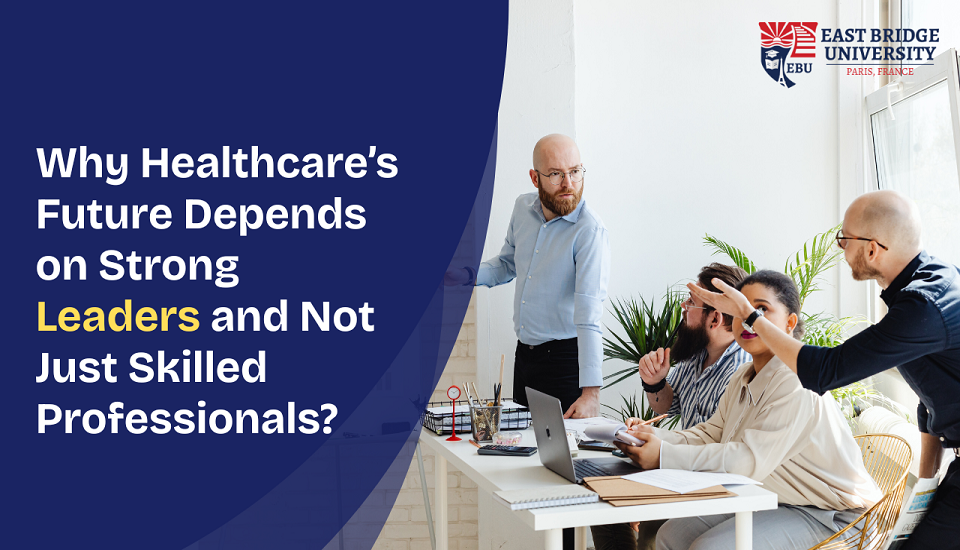
Why Healthcare's Future Depends on Strong Leaders and Not Just Skilled Professionals?
Think about the last time you read a headline about international healthcare. It likely wasn't about a lack of medical breakthroughs or a shortage of cutting-edge technology. Instead, it was almost definitely about systemic pressure: overwhelmed networks, soaring operational costs, cyber vulnerabilities, or the staggering rates of staff burnout.
For decades, the standard career route in medicine was straightforward. You entered the field as a practitioner, a doctor, nurse, pharmacist, or technician, and focused completely on clinical outcomes. But today, the world is realizing a hard truth: a hospital filled with brilliant clinical minds can still fail if the system itself is mechanically broken.
The worldwide healthcare landscape is no longer just a medical field; it is a complex, multi-trillion-dollar ecosystem operating under penetrating pressure. To survive and thrive, it needs more than just highly skilled professionals. It needs visionaries who understand how the pieces fit together. It requires individuals ready to drive systemic change and an MSc in International Healthcare Management is progressively becoming the bridge that transforms dedicated professionals into those essential leaders.
The Change from Management to Global Leadership
We frequently use the words "manager" and "leader" interchangeably, but in contemporary health systems, they mean totally different things. A manager keeps the current system running efficiently; they handle the scheduling, monitor budgets, and ensure standard protocols are followed.
Right now, healthcare systems worldwide are facing what experts call a basic bottleneck. According to the World Health Organization (WHO), there is a projected global shortfall of 11 million health workers by 2030. When you combine this talent deficit with a global average medical inflation rate that hovers around 11.6%, it becomes clear that simply working harder within the old framework isn't sustainable.
"We cannot solve our problems with the same thinking we used when we created them." - Albert Einstein.
True leadership means stepping back to re-architect how care is delivered. It means understanding how a policy decision in Europe influences supply chains in Asia, or how artificial intelligence can be integrated to reduce administrative burdens so clinicians can actually focus on patients.
The Rise of Healthcare Leadership Careers
Numerous people still associate healthcare careers primarily with clinical roles. However, some of the fastest-growing opportunities are emerging in healthcare management and leadership. According to the U.S. Bureau of Labor Statistics, employment of medical and health services managers is projected to grow by 23% between 2024 and 2034, significantly faster than the average growth rate across occupations. Approximately 62,100 openings are expected annually during this period.
This growth reflects a global reality. Healthcare organisations increasingly need professionals who can oversee operations, manage budgets, implement new technologies, improve efficiency, and lead multidisciplinary teams.
Why a Global Lens Matters?
Healthcare used to be penetratingly local. Today, it is fundamentally consistent. A health crisis on one continent can disrupt manufacturing lines on another within days. Furthermore, the challenges healthcare systems face, whether it’s managing aging populations in Japan and Italy or scaling digital health infrastructure across Sub-Saharan Africa cross national borders. When you study healthcare through a global lens, you stop viewing problems in isolation. You learn to adapt best practices from diverse frameworks.
For instance, how do different countries balance public funding with private innovation?
How do international regulatory bodies evaluate new digital therapies?
By mastering these dynamics, you gain the cultural agility and strategic depth required to lead multinational healthcare organizations, non-governmental organizations (NGOs), or public health agencies.
Unprecedented Opportunities in a Growing Field
If you are considering making the leap from a decently clinical or entry-level administrative role into high-level strategy, the data is heavily in your favor. The demand for specialized oversight is growing at an extraordinary pace.
According to data from the U.S. Bureau of Labor Statistics (BLS), employment for medical and health services managers is projected to grow 23% over the next decade, a rate that is vastly faster than the average for almost all other occupations. This trend is mirrored worldwide as health systems restructure to find operational efficiencies.
An MSc in International Healthcare Management prepares you to step directly into these high-stakes roles. It equips you with a robust toolkit that bridges the gap between medicine and business:
Data-Driven Decision Making: Learning to interpret complex health metrics to optimize patient flow and resource allocation.
Crisis Management & Resilience: Building adaptable protocols to protect facilities against everything from pandemic surges to major cybersecurity breaches.
Strategic Human Resource Management: Finding innovative ways to improve staff retention and redesign workflows to reduce chronic burnout.
Why Leadership Matters in Modern Healthcare?
Imagine a hospital introducing a new digital health platform. The technology itself may be advanced, but successful implementation depends on leadership. Someone must coordinate departments, train staff, manage resistance to change, ensure compliance, monitor outcomes, and keep patient care at the centre of every decision.
The same applies to public health programmes, healthcare startups, insurance systems, research institutions, and international healthcare organisations.
Leadership is what transforms good ideas into meaningful outcomes.
Strong healthcare leaders help organisations:
- Improve patient experiences
- Strengthen workforce engagement
- Navigate regulatory changes
- Implement innovation effectively
- Improve operational efficiency
- Respond to healthcare crises
- Drive sustainable growth
In many cases, the quality of leadership directly influences the quality of care people receive.
Why Global Healthcare Needs International Perspectives?
Healthcare challenges rarely stay within national borders.
Pandemics, workforce migration, technological advancements, ageing populations, and health inequities affect countries around the world. As healthcare becomes increasingly global, leaders must understand how different healthcare systems operate and learn from international best practices.
An MSc in International Healthcare Management prepares professionals to think beyond local healthcare challenges. It develops an understanding of healthcare systems from a global perspective while building practical leadership and management capabilities. Students gain insights into healthcare policy, strategic planning, healthcare economics, organisational behaviour, quality improvement, and innovation management.
These skills are valuable across hospitals, healthcare corporations, government agencies, NGOs, international organisations, and private healthcare providers.
Is This the Right Step for You?
You don’t need a background as a surgeon or a chief financial officer to pursue this path. The beauty of a specialized master's program is that it acts as an equalizer, drawing a diverse cohort of professionals.
If you are a doctor or nurse feeling restricted by administrative boundaries, this degree gives you the institutional leverage to alter the environments in which you practice. If you come from a business, legal, or tech background, it provides the deep contextual knowledge needed to apply your skills to the uniquely sensitive world of patient care.
Ultimately, the choice to step up comes down to impact. You can continue to treat patients one by one, a noble and vital pursuit or you can choose to influence the policies, budgets, and technologies that dictate how millions of people receive care.
Looking Ahead
The future of healthcare is being written right now by those who refuse to settle for the status quo. If you're ready to move past simply navigating the system and start actively reshaping it, exploring an MSc in International Healthcare Management is the definitive place to begin. Healthcare needs professionals with expertise. But it also needs leaders with vision.
As global healthcare systems continue to evolve, the demand for individuals who can combine healthcare knowledge with strategic leadership will only grow stronger.
FAQs
1. What is an MSc in International Healthcare Management?
An MSc in International Healthcare Management is a postgraduate programme that combines healthcare knowledge with management and leadership skills. It prepares professionals to manage healthcare organisations, lead teams, improve healthcare services, and address global healthcare challenges.
2. Who should pursue an MSc in International Healthcare Management?
This programme is suitable for healthcare professionals, administrators, managers, policymakers, and graduates who want to build leadership skills and advance into management roles within the healthcare sector.
3. What career opportunities are available after completing an MSc in International Healthcare Management?
Graduates can pursue roles such as Healthcare Manager, Hospital Administrator, Healthcare Consultant, Operations Manager, Healthcare Project Manager, Policy Advisor, Quality Improvement Manager, and Healthcare Executive.
4. Why is healthcare leadership important today?
Healthcare organisations face increasing challenges such as workforce shortages, digital transformation, rising patient expectations, and operational complexity. Effective leaders are needed to manage these changes and improve healthcare outcomes.
5. How does an MSc in International Healthcare Management differ from a clinical qualification?
While clinical qualifications focus on patient care and medical practice, an MSc in International Healthcare Management focuses on leadership, strategy, healthcare operations, policy, finance, and organisational management.
6. Is there a growing demand for healthcare managers globally?
Yes. Healthcare systems worldwide are expanding and evolving, creating strong demand for professionals who can lead organisations, manage resources effectively, and drive innovation across healthcare settings.
7. What skills can students develop through this programme?
Students typically develop skills in healthcare leadership, strategic planning, financial management, healthcare policy, quality improvement, change management, communication, and decision-making.
8. Can this degree help professionals’ transition into leadership roles?
Yes. An MSc in International Healthcare Management is designed to help professionals move beyond technical or clinical roles and take on leadership positions with greater organisational responsibility and impact.
Comments & Replies
Read what others are saying and share your thoughts below.
Leave a Reply