

Beyond the Basics: Can a Human Services Degree Launch Your Counseling Career?
If you're reading this, you likely have a drive to help others. Maybe you’re presently working in a community role, or perhaps you’re a student staring at your course catalog, wondering: Does a Human Services degree actually lead to a career in counseling?
The honest answer is yes, it can be a strong starting point. It’s one of the most common questions in the helping professions and for good reason. Both fields share a common heartbeat: the desire to support people through life’s hardest transitions. But while they are siblings in spirit, they are different in practice.
Still, for numerous learners and working specialists, a human services background can open the door to eloquent roles in mental health support, community services, family welfare, youth work, restoration, crisis support and ultimately formal counselling practice with the right additional training.
Let’s break down how you can bridge that gap and turn your passion for advocacy into a profession in counseling.
Why & How Human Services and Counselling Are Connected?
Human service is a broad field focused on helping people improve their quality of life. It brings together areas such as psychology, social work, community development, case management, advocacy, mental health support and family services.
Counselling, on the other hand, is more focused on helping individuals, couples, families or groups work through emotional, behavioural or personal challenges. Counsellors may support people dealing with stress, anguish, anxiety, relationship issues, trauma, addiction, career confusion or life evolutions.
The two fields overlap because both are built on empathy, communication and practical support. A human services degree frequently introduces you to the foundations of human behaviour, social systems, ethics, diversity, intrusion planning and support services. These are all useful if you later decide to move into counselling.
In simple terms, human services can help you understand people in context. Counselling helps you support them through structured conversations and therapeutic approaches.
Why Human Services is the Perfect "Secret Weapon"?
Don’t be disheartened if you’ve already started (or finished) a Human Services degree. You haven’t wasted your time far from it. In fact, Human Services graduates regularly make the most well-rounded counselors as they already understand the social determinants of health.
When you sit across from a forthcoming client, you won’t just see their symptoms; you’ll see the context of their life. You’ll understand how poverty, systemic barriers, and community resources impact their mental well-being. This perception, often called "systems-thinking," is a huge asset in therapeutic settings that many pure psychologies majors lack.
Why Does This Career Path Matter Today?
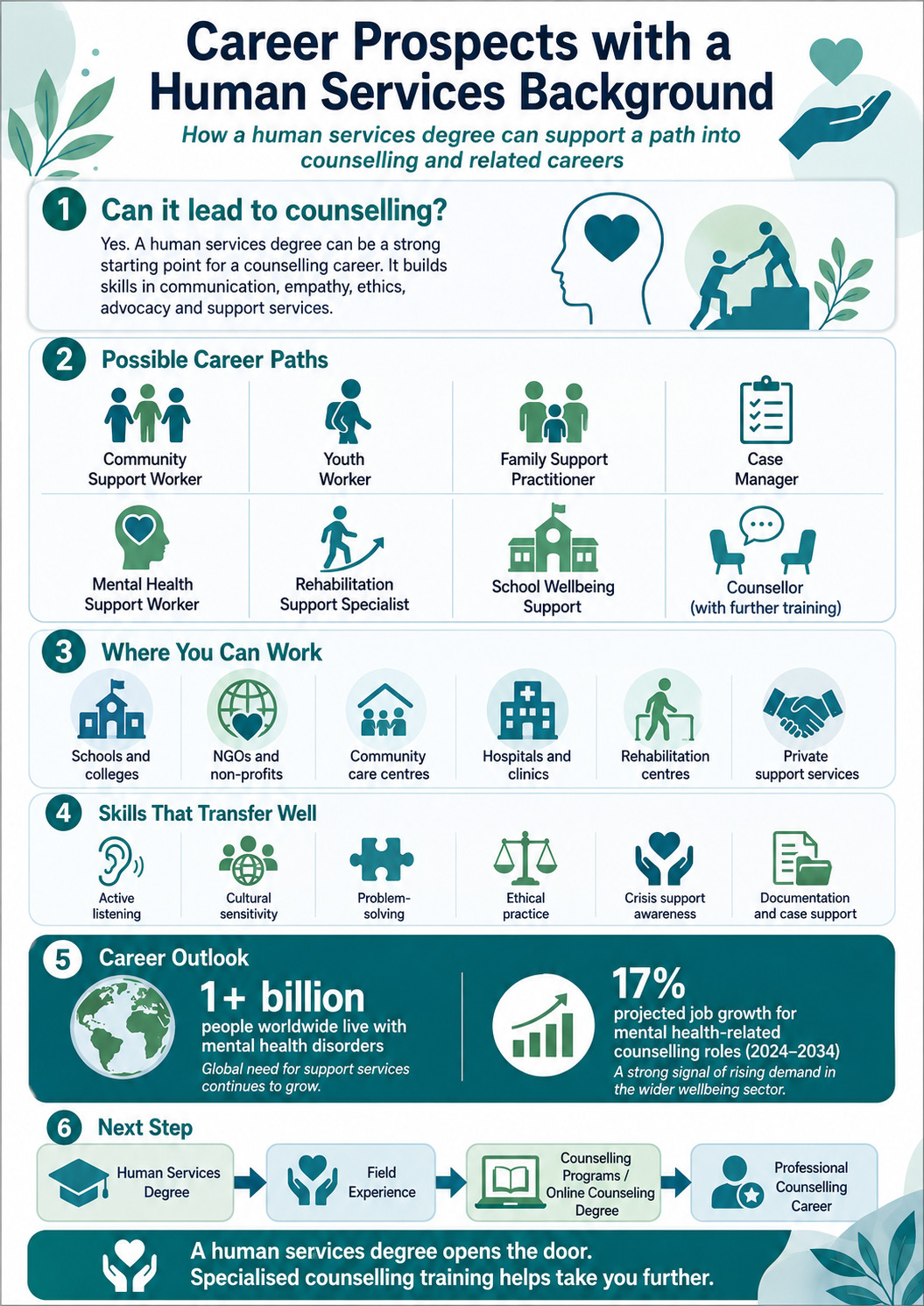
The need for mental health and support professionals is increasing across the world. The World Health Organization has reported that more than 1 billion people are living with mental health disorders worldwide. This shows how urgent the demand is for skilled professionals who can support emotional wellbeing, early intervention and community care.
Job growth also reflects this demand. In the United States, employment for substance abuse, behavioural disorder and mental health counsellors is projected to grow by 17% from 2024 to 2034, which is much faster than the average for all professions.
While job titles and licensing rules fluctuate across countries, the international message is clear. Schools, workplaces, hospitals, NGOs, community centres and private organisations are all recognising the need for stronger mental health and wellbeing support.
This is why several learners are now discovering counselling programs after completing or considering a human services qualification.
What Can You Do with an Online Counseling Degree?
An online counseling degree can prepare you for various people-focused roles. These may not always be clinical counselling roles at first, but they can help you build appreciated experience.
You may work in:
- Community support services
- Youth and family welfare
- Mental health support organisations
- Disability services
- Rehabilitation centres
- Non-profit organisations
- Crisis support services
- School or student support settings
- Addiction recovery support
- Case management
- Social service administration
These roles help you understand real human challenges. You learn how social, emotional, financial, cultural and family-related problems affect people’s lives. This experience can become very useful if you later enter counselling training. For example, a case support worker may regularly interact with families in crisis. A youth worker may support young people facing emotional or behavioural challenges. A community service professional may help vulnerable groups access care, education or employment support. These experiences can sharpen your listening skills, emotional awareness and professional judgement.
Can It Lead Directly to a Counselling Job?
This depends on where you live and what kind of counselling role you want. In some countries, entry-level support roles may use titles such as mental health support worker, wellbeing officer, guidance assistant, community counsellor or support practitioner. This degree may help you qualify for such positions, particularly if the role is non-clinical.
However, becoming a licensed or registered counsellor typically requires additional education, supervised practice and professional approval. In various countries, formal counselling roles require postgraduate study, a specialised counselling qualification, supervised clinical hours or membership with a recognised professional body.
This is where an online counseling degree becomes a valuable next step, exclusively for working professionals who need flexibility. Online study can allow you to build counselling knowledge while continuing your current job. However, you should always check whether the programme meets the professional requirements in your country or the country where you plan to work.
The key point is this: a human services degree can start the journey, but additional counselling training may be needed for professional counselling practice.
Is This Path Right for You?
A human services degree may be right for you if you care about people, want a flexible career path and are interested in social influence. It can also be a good choice if you are not yet ready to commit to one narrow specialisation.
You can begin with broad human services knowledge, gain field experience and then move towards counselling if that interest grows stronger.
This path is especially suitable for people who want work that feels meaningful. It may not always be easy. Helping professions can be emotionally demanding. But they can also be deeply rewarding because your work can support real change in someone’s life.
Final Thoughts
So, can a human services degree lead to a counselling career? Yes, it can. It can give you the human understanding, practical exposure and support-based foundation needed for counselling-related work.
However, if your goal is to become a professional counsellor, you may need further study, supervised training or registration depending on your location. An online counseling degree can open the door, while specialised counselling programs can help you move closer to formal practice.
In a world where emotional wellbeing is becoming a universal priority, trained and compassionate support experts are needed more than ever. With the right education and clear career planning, your interest in human services can grow into a purposeful counselling career.
FAQs –
1. Can a human services degree lead to a counselling career?
Yes, a human services degree can be a strong starting point for a counselling career. However, licensed counselling roles may require additional qualifications, supervised practice or professional registration depending on the country.
2. What jobs can you get with a human services degree?
You may work in community support, mental health services, youth welfare, family support, case management, rehabilitation centres, crisis support or non-profit organisations.
3. Do you need further study after a human services degree?
Yes, if you want to become a professional or licensed counsellor, you may need further study through counselling programs, postgraduate training or an online counseling degree.
4. Is an online counseling degree useful?
An online counseling degree can be useful for working professionals who need flexible study options. Always check whether the programme meets local professional or licensing requirements.
5. Are human services and counselling the same?
No. Human services is broader and focuses on community support and social care. Counselling is more specialised and focuses on emotional, behavioural and mental wellbeing support.

Comments & Replies
Read what others are saying and share your thoughts below.
Leave a Reply